Experience the future: see today what evolves tomorrow
Precise and digitized design with Building Information Modeling (BIM)
A cooperative, forward-looking planning is needed so that complex construction projects succeed. Model-based work is essential for this process. With Building Information Modeling (BIM) we have a highly innovative method at our disposal for several years with which virtual, three-dimensional building models can be generated out of all collected design data in multidisciplinary and centralized work – long before the actual building is taking shape.
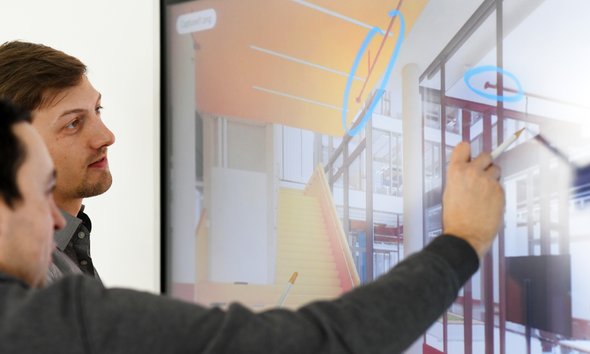

In this way, construction projects can be comprehensively illustrated already at an early stage: technically, functionally and in terms of architectural design as well as with regard to the project execution, costs and schedules. The BIM method is particularly suitable for the design of complex buildings, but also for difficult civil engineering structures and advanced transport infrastructure projects.
Although this type of intelligent, data-based building modeling is still under development, we have consistently focused our working processes on this technique for several years. With many years of experience as a general planner, BIM is not just a vision of the future at iproplan®, but an aspiration: we therefore work continuously on the efficient implementation and optimization of this method in diverse projects. In-house BIM coordinators take care of consistent knowledge transfer and a smooth technical execution; our employees are regularly trained on the latest technologies. Planning and design become more transparent and precise. – A real promise of quality!
What are the actual benefits of BIM?
Quality through transparency
Data-based modeling brings together all planning-related information in a virtual format. This allows for a wide range of simulations and evaluations to be carried out on the model at an early stage: risks of undesirable effects in the construction and operation of a building can be minimized, and potential collisions can be identified and eliminated. Schedule and cost planning can also be optimized on this basis.
Better coordination of planning partners
All specialist planners involved work together in the same model. This facilitates interdisciplinary collaboration between individual engineers and architects and makes it more efficient. Their communication has the same basis: planning variants can be played through more easily; changes are immediately visible in the model for all parties involved.
Up-to-date and accurate
All planning data is stored centrally in the model – collected throughout the entire project period. The model is therefore always up to date with the latest planning status and reflects all technical planning details. This enables decisions to be made in the project context based on current, reliable data.
Sustainability in the planning process
The scope and precision of the modeling allow a building to be viewed over its entire life cycle: from planning and execution to operation and maintenance. The model “grows” with its tasks.
Kontakt
Ronny Windisch
 windisch.ronny[at]iproplan.de
 +49 371 52 65 458

CONTACT US
Ronny Windisch
- windisch.ronny[at]iproplan.de
- Phone
- +49 371 52 65 458